Invasive Species Management
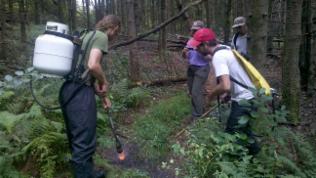
Early Detection/Rapid Response team stopping Japanese stiltgrass in its tracks.
Our Approach:
We offer comprehensive invasive species management services to partners who recognize the threat that invasive species pose to native biodiversity and ecosystems. We are unique in this field in that we are practitioners guided by a land ethic and ecological restoration science and practice. We read the literature, attend meetings and conferences, correspond with networks of colleagues, and experiment continually so that we can offer our partners the best invasive plant management services.
Control work usually consists of one initial treatment followed by two follow-up treatments in order to obtain 99% control within three years for most invasive plant species. A stewardship/maintenance phase of work follows the invasive plant management and assures partners that the effort/investment is protected and that the cycle of reintroduction and lack of awareness will not continue. Early Detection and Rapid Response protocols figure prominently into the longterm land stewardship. The end goal is to train and educate our partners so that they will take over stewardship duties. Restoration is realized once the native species displaced by the invasive plants are restored to the site and the secondary ecological effects of herbicides or other invasive eradication methods are reduced to a minimum. We have managed many invasive plant management projects throughout the New England region over the last ten years including coastal saltmarsh restoration projects featuring Phragmites, miles of Japanese knotweed dominated streambanks, and thousands of acres of land dominated by woody invasive shrubs.
Invasive Plant Control
We use mechanical methods, biocontrol agents, conservation grazing, soil amendments, judicious use of herbicides, & native plant revegetation strategies to effectively manage small and large-scale invasive plant populations.
We are not nozzle heads! Herbicides are powerful tools, but should be used in a careful, restrained and judicious manner. We provide partners with effective options that integrate management techniques and exploit weaknesses in individual invasive plants based on plant phenology. We are also able to consider solutions that don't involve synthetic herbicides. For example, propane torching is a viable option for Japanese barberry, honeysuckle and early seedlings.
Mapping, planning, success criteria, & monitoring is addressed in every project.
We offer services to manage and control a host of invasive plant species including:
| Invasive Trees | Invasive Herbaceous Plants |
| Norway Maple (Acer platanoides) | Japanese Knotweed (Polygonum cuspidatum) |
| Tree of Heaven (Ailanthus altissima) | Common Reed (Phragmites australis) |
| Black Locust (Robinia pseudoacacia) | Reed Canary Grass (Phalaris arundinacea) |
| Invasive Shrubs | Japanese stiltgrass (Microstegium vimineum) |
| Glossy Buckthorn (Frangula alnus) | Black swallowwort (Cynanchum louiseae) |
| Common Buckthorn (Rhamnus cathartica) | Pale swallowwort (Cynanchum rossicum) |
| Winged Euonymus (Euonymus alatus) | Garlic Mustard (Alliaria petiolata) |
| Bush Honeysuckle (Lonicera spp.) | Purple Loosestrife (Lythrum salicaria) |
| Japanese Barberry (Berberis thunbergii) | |
| Autumn Olive (Elaeagnus umbellata) | |
| Multiflora Rose (Rosa multiflora) | |
| Invasive Vines | |
| Asiatic Bittersweet (Celastrus orbiculatus) |
Please check back- we will soon outline our management strategies for individual invasive plants
New Species on our Radar Screen: Large Gray Willow (Salix cinerea), Hardy Kiwi (Actinidia arguta) and Mile-A-Minute Vine (Persicaria perfoliata).
Japanese Knotweed Album: Link
Phragmites Mowing Album: Link
Planning
Planning is an essential step in our invasive plant management process and includes the following elements:
Define conservation goals & objectives
A map designating invasive plant management units as well as sensitive resource areas (wetlands, wells, endagered species, etc.).
Management priorities and timeline - it may not be feasible or necessary to do all work at once. Some invasive plants may interfere with your goals/objectives more than others.
Early Detection & Rapid Response (EDRR): it is essential that land managers be familiar with invasive plant species that are predicted for the region. Often these species are overlooked and are not recognized as a threat until they are well established and therefore difficult to control. Early detection species are easy to control in the early stages and can usually be contained without the use of herbicides or other intesive procedures. For more information: Invasive Plant Atlas of New England
Management options: not every project is the same and it is important to lay out control options and strategy. For example, one landowner may be strongly opposed to the use of herbicides and may need to consider a more mechanical approach.
Success Criteria
Monitoring
Cooperative Weed Management Areas (CWMA)
We are huge fans of this concept and will offer our support to these endeavors that seek to bring people together in a particular region to look at the landscape scale invasive species issues/occurrences rather than individual property to property.
More information:
Best Management Practices for the Prevention and Treatment of Terrestrial Invasive Plants in Vermont Woodlands written by Redstart Forestry with contributions from us here at Polatin Ecological Services. Awesome primer resource for Vermont specifically and New England generally.
Developing Bid Specifications for Invasive Plant Control Programs by Invasive Plant Control, Inc. This document is very informative for those putting together projects.
The Nature Conservancy's Weed Control Methods Handbook: Tools & Techniques for Use in Natural Areas This document does a great job of describing your options for management.
The Nature Conservancy's Element Stewardship Abstracts This is the first place you go to study up on your invasive plant.
Glossary:
(Adapted from The Evaluation of Non-Native Plant Species for Invasiveness in Massachusetts)
Invasive species - Plants that have spread into native or minimally managed plant systems. These plants cause economic or environmental harm by developing self-sustaining populations and becoming dominant and/or disruptive to those systems.
Native or Indigenous species - otherwise a species that occurs natively within a region. Indigenous species often have a precolonial presence (pre 1500) or have arrived in the region more recently without the aid of human intervention.